
Why 60% of Searches Don't Click (And How to Track Revenue From AI Citations Anyway)
TL;DR
Stop panicking over a 15-30% drop in organic traffic. It doesn't mean your SEO is broken; it means your buyers have moved to zero-click platforms where the value is invisible to your current dashboard. These "ghost" users consume your answer in ChatGPT, close the tab, and buy later—a high-intent behavior that converts at 4.4x the rate of traditional search yet remains completely undetectable by standard 30-day attribution windows. The fix is to stop trusting default settings: switch to a 90-day window, track Branded Search Lift, and force the issue with specific discovery surveys. It is time to stop optimizing for vanity clicks and start optimizing for the answer that actually drives the sale.
The Problem: The "Traffic Crash" Illusion
Your Google Analytics shows organic traffic is down 20% year-over-year. Your CMO is asking why SEO is "failing." Yet, your revenue is holding steady or even growing.
You are living in the Zero-Click Paradox.
As of 2026, 58.5% of US searches (and nearly 60% in the EU) end without a click to any website. When an AI Overview (AIO) triggers, that zero-click rate jumps to 83%.
Most marketers look at this data and see a disaster. They see "lost traffic."
They are wrong.
If a potential buyer asks ChatGPT for the "best enterprise CRM," reads a citation about your brand, closes the tab, and then comes back three weeks later to buy directly—you didn't lose a customer. You just lost the ability to track them with a 2015 methodology.
The problem isn't the channel. It's your attribution model. You are trying to measure AI influence with a pixel designed for banner ads.
The Framework: The Invisible Revenue Triangle
You cannot track AI influence with a cookie. ChatGPT won't let you, and Claude doesn't care about your tracking script. To measure GEO (Generative Engine Optimization) ROI, you must triangulate data using three specific signals.
Stop looking for a single "Source: ChatGPT" line in GA4. It doesn't exist. Instead, map your revenue against these three proxies:
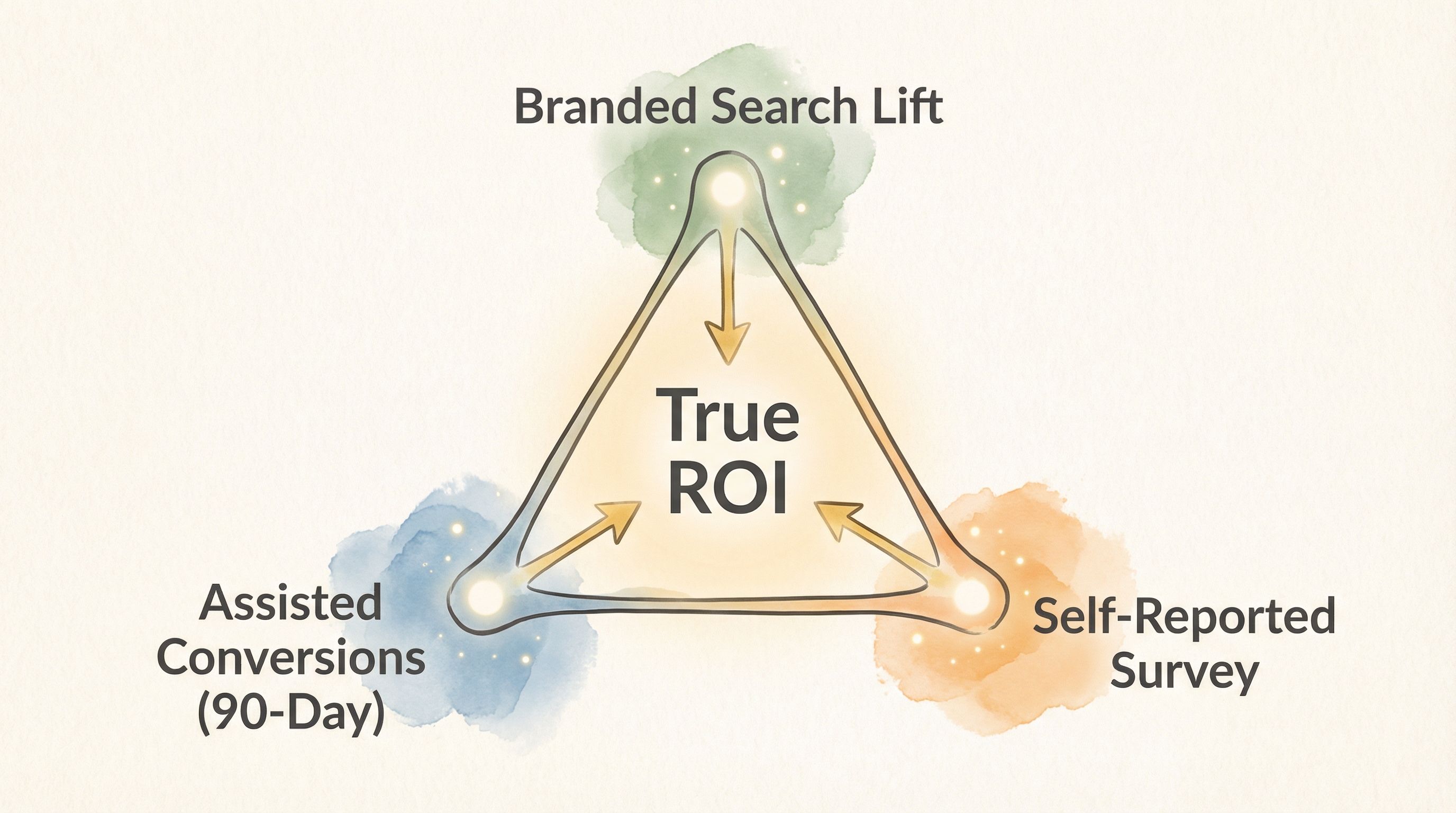
The Invisible Revenue Triangle
| Signal | Tool | What It Measures | The Lag Time |
|---|---|---|---|
| 1. Branded Search Lift | Google Search Console | Users who saw you in AI, then Googled your name. | 7-30 Days |
| 2. Assisted Conversions | GA4 (90-Day Window) | Users who touched your site months ago but converted later. | 30-90 Days |
| 3. Self-Reported Attribution | Post-Purchase Survey | Users explicitly telling you "I found you on Perplexity." | 0 Days (Real-time) |
The Insight: If Signal 1 and Signal 3 are spiking while your "Organic Traffic" is flat, your marketing is working. You are just winning in the dark.
How to Fix Your Attribution (A 4-Step Guide)
Step 1: Extend Your Blind Spot (The 90-Day Fix)
The standard Google Analytics attribution window (often default to 30 days or even 7 days for ads) is useless for AI discovery.
The AI buyer's journey is non-linear:
- Day 1: Ask Perplexity for software recommendations. (See your brand).
- Day 15: Discuss with team.
- Day 45: Google your brand and book a demo.
If your window is 30 days, GA4 credits "Direct" or "Organic." The AI influence is erased.
Action: Go to Admin → Data display → Events → Attribution settings. Set your "Reporting attribution model" to Data-driven. Then, change your "Key event lookback window" to 90 days (the maximum allowed). Stop letting default settings hide your revenue.
Step 2: Track the "Ghost" Lift
When AI models cite you, users don't click the link; they memorize the name.
If you start optimizing for GEO in January, and your visibility in ChatGPT increases from 0% to 20% by March, look at Google Search Console for your brand name (e.g., "Beonai").
If your branded search volume spikes by 30% in correlation with your AI visibility increase—while your generic keyword traffic stays flat—that delta is your AI-attributed traffic.
Step 3: Ask the "Zero-Click" Question
Digital data is imperfect. Human data is blunt.
You need a post-purchase survey on your thank-you page. But 90% of brands write this wrong.
- Bad: "How did you hear about us?" (Options: Google, Social, Friend)
- Good: "How did you first discover us?" (Options: AI Search / ChatGPT, Google Search, LinkedIn, etc.)
The Rule: If a user selects "AI Search," trigger a follow-up: "Which one?" (ChatGPT, Perplexity, Gemini).
You will find that 10-15% of your "Direct" conversions are actually "AI" conversions that your pixel missed.
Step 4: Calculate Real ROI
Don't use vanity metrics. Use this formula to prove value to your CFO:
(Branded Search Lift × Conversion Rate × AOV) + (Self-Reported AI Revenue)
Example:
- Branded Search Lift: +500 visits
- Conv. Rate: 3%
- AOV: $500
- Math: (500 * 0.03 * 500) = $7,500
- Plus: $3,000 from customers who clicked "AI Search" in survey.
- Total AI Revenue: $10,500/month.
Compare that to the cost of your content. That is your ROI.
The Insight
Stop chasing clicks. Start chasing influence.
Track What Actually Matters
Most "AI Visibility" tools are passive dashboards. They show you a pretty chart of your visibility dropping, but they don't tell you how to fix it.
Beonai is different. It is an Action Engine.
1. Measure the Impact (The CFO's Favorite Part)
- Multi-LLM Visibility: Track your Visibility Score across ChatGPT, Gemini, and Perplexity in real-time.
- Share of Voice (SOV): Know exactly how often AI recommends you vs. your competitors.
- Sentiment Analysis: Fix reputation issues before they spread by tracking positive vs. negative brand descriptors.
- Competitor Metrics: See which competitors dominate which prompts—and why.
- Citations Analysis: Identify exactly which third-party sources are driving your AI mentions.
2. Execute the Strategy (The Marketer's Favorite Part)
- Actionable Opportunities: Receive specific, weekly tasks to improve your citation velocity. No guessing.
- Content-Gen Workflows: Use our AI-assisted tools to build the exact "Data Magnet" blogs and reports that LLMs love to cite.
- Conversation Tracking: Identify and engage in the Reddit threads and forums where your brand is being discussed right now.
You are moving your money to the future. Make sure you have the tools to win there.
Common questions
How long does it take to see revenue from AI citations?
It is a mid-to-long game. While visibility can spike in weeks, the revenue impact typically lags by 30 to 90 days. If you pull the plug at month 2 because "sales aren't up," you are quitting right before the harvest.
Can't I just use UTM parameters?
Rarely. AI models often strip UTMs, or users simply don't click the link at all (hence "zero-click"). UTMs will underreport your AI success by 80%+. Use them, but do not rely on them.
Does this apply to B2C?
If you sell high-consideration items (luxury travel, tech, finance), yes. If you sell $5 socks, no. AI is a research engine, not an impulse-buy engine.
My boss only cares about traffic charts. How do I explain this?
Show them the Discovered Labs stat: AI-referred leads convert at 4.4x the rate of traditional search. Ask them: "Do you want 1,000 tire-kickers or 100 buyers?"
Is the "35% boost" real?
Yes. Bain & Company data confirms that brands cited in AI answers see a 35% boost in organic CTR when users eventually do search for them. The AI citation acts as a "pre-approval" badge.
Which tool tracks the initial visibility?
You can't manage what you don't measure. Beonai tracks your citations across ChatGPT, Perplexity, and Gemini, distinguishing between passing mentions and strong recommendations so you can correlate visibility to revenue.