

What is Generative Engine Optimization (GEO)? The 2026 Guide for Brand Marketers
TL;DR
Google Search volume is predicted to drop 25% this year as users shift to asking AI agents. SEO isn't dead, but the gears have changed. Generative Engine Optimization (GEO) is the new art of ensuring your brand is the *cited authority* in those answers, not just a link on a page. This guide dismantles the "Visibility Theater" and provides a framework to build the **Visibility** that actually drives revenue.
The Gears Have Changed
We all know the shift has happened.
Saying "users are asking AI instead of searching Google" is like explaining how AirDrop works. We know. You probably asked Perplexity or ChatGPT a question this morning without even thinking about it.
SEO is not dead. It is still critical. You still need a fast site and good content. But the gears of discovery have shifted.
Your dashboard probably shows you ranking #1 for "best email api". It shows steady impressions. It looks like you're winning.
But if you look at your revenue, the story is different.
When a developer asks an AI, "Which email API has the best DX (Developer Experience) for a Next.js app?", the AI doesn't give them a list of ten blue links. It gives them a verdict.
It acts like a technical consultant, synthesizing documentation, GitHub discussions, and Reddit threads into a single recommendation.
If your brand isn't in that answer, you haven't just lost a click. You've been erased from the consideration set.
This is the fundamental disconnect of 2026:
- SEO is convincing a robot to put you on a list.
- GEO is convincing an intelligence to speak your name.
2. The Problem: "Visibility Theater"
Most marketers are currently stuck in "Visibility Theater." They are optimizing for a world that existed in 2023.
They are fighting for:
- Blue Links: Ranking on Page 1 (which is now pushed below the AI answer).
- Generic Keywords: Trying to own "transactional email" (a query AI answers instantly with a table).
- Backlinks: Chasing links from random marketing blogs.
Meanwhile, the "Displacement Danger" is real.
Imagine a developer asks Perplexity: "Which email service is easiest to set up for a React project?"
The AI doesn't look at who has the most backlinks. It looks for citation density and extractable facts. It scans specific developer communities.
If SendGrid or Mailgun are mentioned in a high-authority thread on r/webdev or a verified review on G2, the AI recommends them.
- Your Result: You ranked #1 on Google for "email api," but you got zero visibility in the actual answer.
- The Competitor's Result: They didn't rank at all, but they won the developer because the AI trusted their "React" association.
You don't just lose the click. You lose the implementation.
3. The Solution: The "GEO Trinity" Framework
If you want to move from "searching" to "answering," you need a new operating model.
Traditional SEO was about keywords and backlinks. Generative Engine Optimization (GEO) is about Entities, Citations, and Structure.
We call this the GEO Trinity.
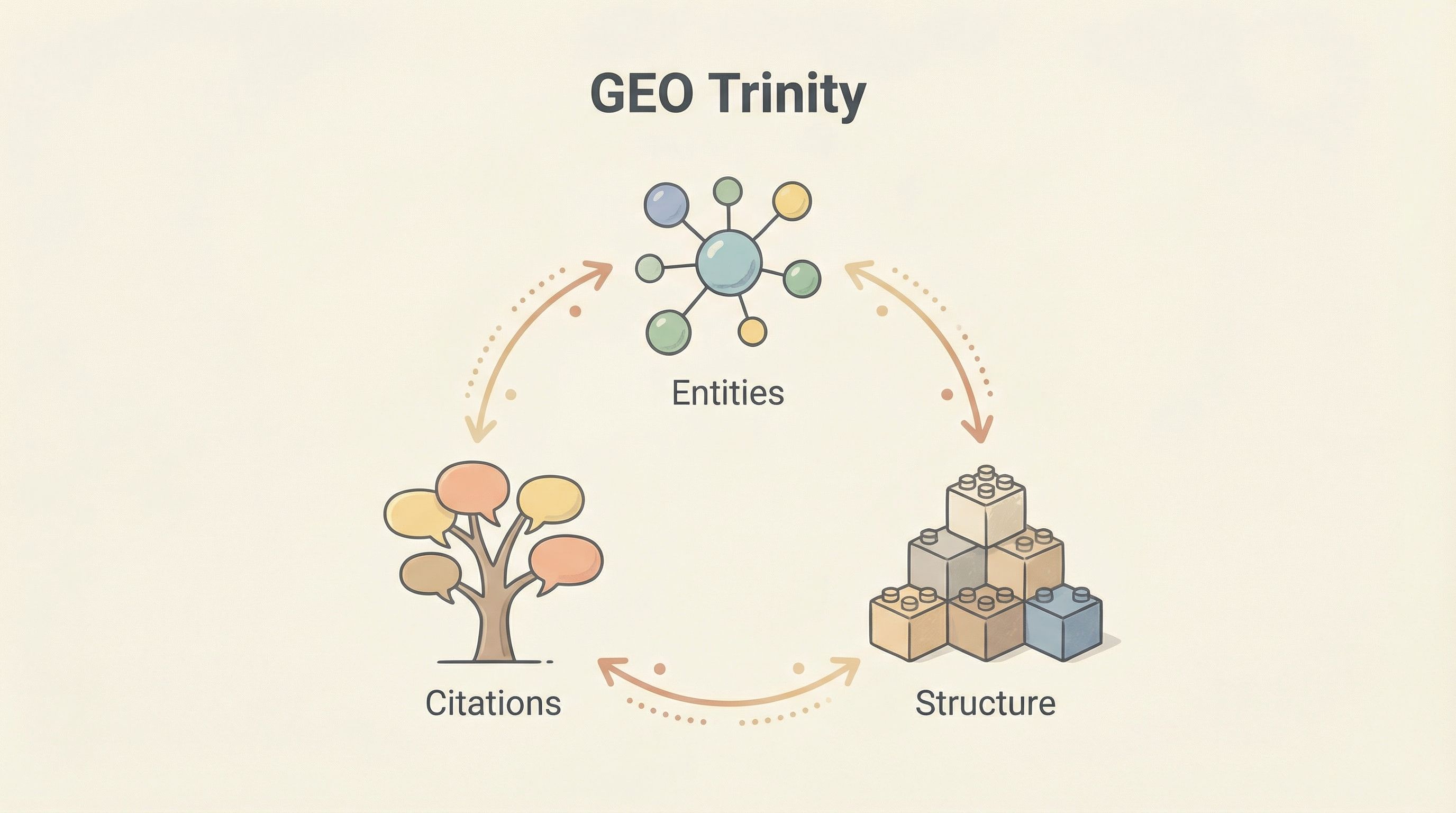
The GEO Trinity Framework
| SEO Focus (Old World) | GEO Focus (New World) |
|---|---|
| Keywords ("Best Email API") | Entities (Your Brand + "Modern DX") |
| Backlinks (Link Juice) | Citations (Brand Mentions) |
| Rankings (Position #1) | Visibility (Frequency of Mention) |
Pillar 1: Entity Density (The "What")
LLMs (Large Language Models, the brains behind AI) do not read pages like humans; they map concepts. They don't just see "email tool"; they see the entity "Resend" and associate it with "React," "modern," and "clean documentation."
The Goal: You want the AI to associate your brand with specific attributes.
- Don't write: "We are a leading provider of email solutions."
- Do write: "Resend is the email API for developers who build with React and Next.js."
Why: The stronger the association between your Brand Entity and the Category Entity (e.g., React Email), the more likely the AI is to recommend you when a user asks about that category.
Pillar 2: Citation Velocity (The "Who")
This is where the science comes in. A landmark study from Princeton University tested thousands of GEO tactics to see what actually convinces an AI to cite a source.
The results were clear. You don't convince an AI by stuffing keywords (which actually hurt visibility by -9%). You convince it with Proof.
- Expert Quotes: Adding quotes from credible authorities increased visibility by +41%.
- Statistics: Including unique, data-backed numbers increased visibility by +30%.
- Citations: Citing other authoritative sources increased visibility by +30%.
The Trust Map: Where do these citations come from? For a tool like Resend, the "Holy Trinity" of trust is:
- G2 & Product Hunt: AI loves aggregated, verified user data.
- GitHub & Documentation: Code snippets and README files are high-trust signals.
- Reddit (r/webdev): Real-world context and developer sentiment.
Pillar 3: Structural Clarity (The "How")
Think of an LLM as a "blind crawler." It is incredibly smart, but it struggles to "see" your content if it is buried in long, winding paragraphs.
You need to create Extractable Artifacts using Schema Markup (code that helps bots understand your content). The formats most likely to trigger citations right now are:
FAQPage: For direct Q&A extraction.Dataset: For original research (AI loves data).TechArticle: For code tutorials and documentation.Organization: To anchor your brand as a real entity.
4. Implementation: The 30-Day GEO Sprint
You cannot fix your entire site overnight. But you can secure your AI Visibility in 30 days with this sprint.
Week 1: The "Zero-Click" Audit
- Identify your top 20 revenue-driving keywords (e.g., "send email node.js").
- Put them into ChatGPT, Perplexity, and Google's AI Overview.
- Track: Are you mentioned? If yes, is the sentiment positive? If no, who is mentioned instead?
- Deliverable: A list of 5 competitors who are "stealing" your visibility.
Week 2: The "Data Magnet" Campaign
- LLMs crave statistics (remember the +30% lift?).
- The Strategy: Publish one piece of content that contains original data no one else has.
- Example: Publish "The State of Transactional Email 2026"—a report on delivery rates or tech stack trends.
- Deliverable: One blog post filled with proprietary stats that AI tools will cite as a primary source.
Week 3: The Formatting Overhaul
- Take your top 10 existing blog posts.
- Add a TL;DR to the top of each (2-3 sentences max).
- Add at least one comparison table to every post (e.g., Resend vs. SendGrid feature list).
- Implement
FAQPageschema. - Deliverable: 10 pages optimized for "Machine Readability."
Week 4: Off-Site "Surround Sound"
- Look at the competitors you found in Week 1. Check the footnotes in the AI answers. Where is the AI getting its info?
- It's likely Reddit threads, Hacker News, or Dev.to.
- Your goal is to get mentioned there.
- Deliverable: A plan to get 3 mentions on the specific third-party sites that define your niche's "ground truth."
5. Brand Tie-In: Stop Watching. Start Acting.
Most "AI Visibility" tools on the market are just passive dashboards. They show you a pretty chart of your visibility dropping, but they don't tell you how to fix it.
BEONAI is different. We are an Action Engine.
We don't just track your visibility. We give you the tools to improve it:
- Actionable Opportunities: Specific, weekly tasks to improve your citation velocity.
- Content-Gen Blogs: AI-assisted workflows to create "Data Magnet" content that ranks.
- Conversations: Identify and engage in the internet chats (Reddit, Forums) where your brand is being discussed right now.
Don't just watch your visibility. Shape it. Join the BeonAI Waitlist
Common questions
Is SEO dead?
No. SEO is the foundation; GEO is the skyscraper on top. You still need technical health and site speed. But your content strategy must shift from "keywords" to "answers" to capture the AI traffic.
Can I just block AI bots from my site?
You can, but it is risky. If you block the bots, you remove yourself from the training data. You are effectively choosing to be invisible to the assistant that 60% of your customers are using.
Does "Brand Sentiment" really matter for rankings?
Yes. Unlike Google Search (which might rank a hated company if they have enough backlinks), AI models have a "safety bias." They often refuse to recommend brands with negative sentiment to avoid giving "bad advice."
How long does GEO take to work?
It can be faster than SEO. Because AI models act like "Retriever-Augmented Generation" (RAG) engines (systems that fetch live data), they can pull fresh info instantly. If you get cited in a high-authority news source today, Perplexity can start citing you tomorrow.
Do I need a new agency for this?
Not necessarily, but you need a new mindset. If your agency is sending you reports on "keyword density" and "backlink quantity," they are optimizing for 2023. Ask them about their Citation Velocity strategy.