

The Complete B2B SaaS Guide to Getting Cited by AI
TL;DR
Your SEO brings traffic, but your buyers moved to ChatGPT. When a CTO asks AI "best project management tool for remote teams" and you don't exist in that answer, you've been erased before the conversation started. The fix: stop optimizing for Google's crawlers, start optimizing for AI's reasoning. This guide shows the exact framework that generated 141 new users in 60 days and why B2B companies with zero backlinks are outranking enterprise brands with 10 years of authority.
You're Invisible Where Buyers Actually Search
A SaaS founder posted this last month:
"Got a Calendly booking. Asked 'How'd you hear about us?' They said 'ChatGPT.' We don't rank on Google for that keyword. No ads. No backlinks. But we showed up inside ChatGPT's answer."
That's the new reality.
89% of B2B buyers now use AI tools during purchasing. Not as a supplement to Google—as a replacement. When they ask "Which CRM integrates best with our tech stack?" they don't click through 10 blue links. They read one AI-generated answer and make a shortlist.
If your brand isn't in that answer, you don't exist.
Meanwhile, your analytics show chat.openai.com appearing as a referral source. Real businesses track real revenue from AI citations. One B2B agency reported 141 new users from ChatGPT in 60 days using a framework they call AISO (AI Search Optimization).
The data backs it up: AI-referred traffic converts at 4.4x the rate of traditional search. These aren't casual browsers—they're pre-qualified buyers who already trust you because an AI recommended you.
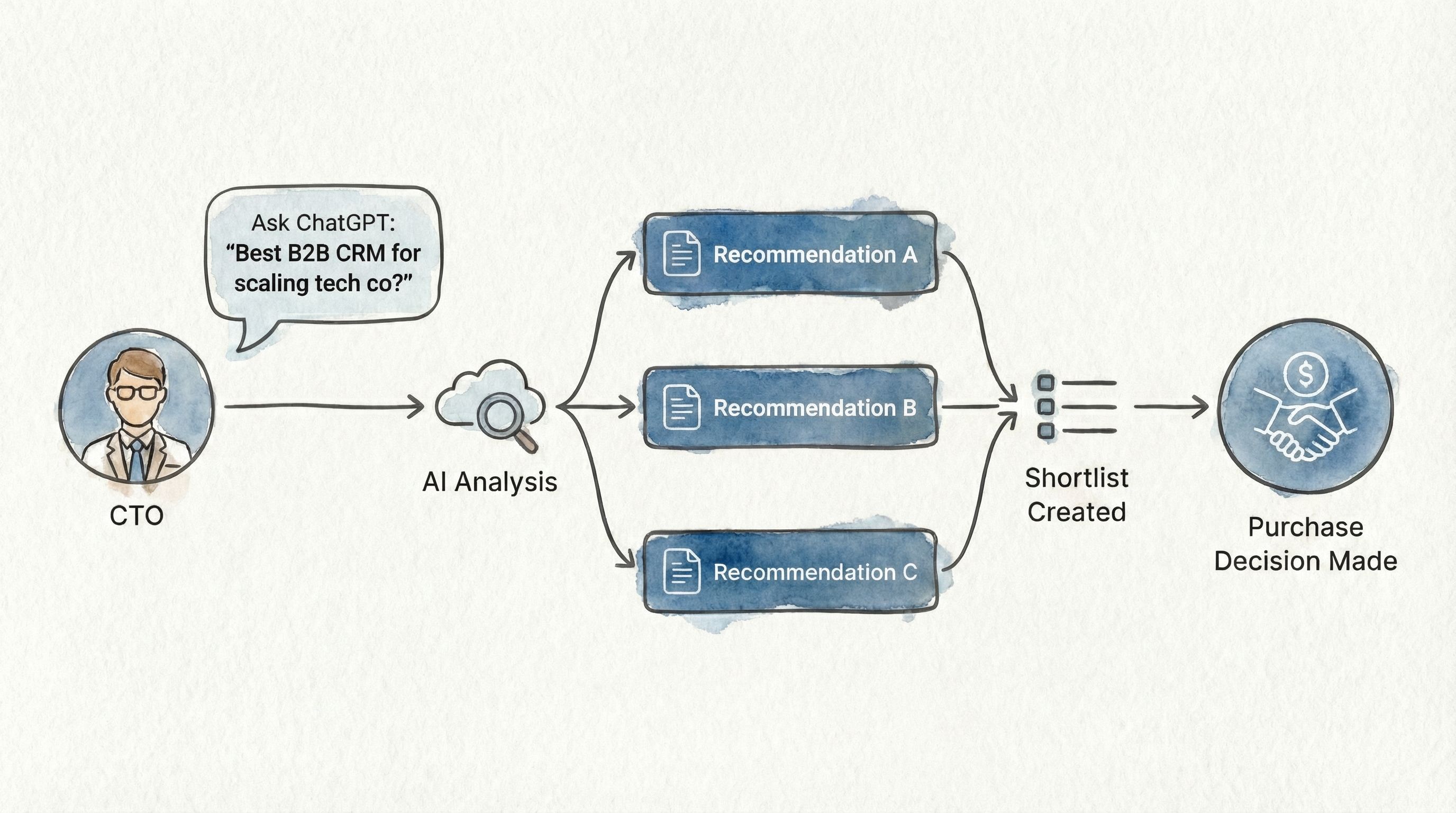
From AI query to purchase
Why Traditional SEO Fails in AI Search
For 20 years, you've played by Google's rules:
- Build backlinks (links from other sites to yours)
- Target keywords
- Optimize meta descriptions
- Chase Domain Authority (a score measuring your site's "trust")
AI doesn't care about any of that.
When ChatGPT or Perplexity answers "best marketing automation for SaaS," it doesn't check your authority score or count your backlinks. It scans for clear information, good structure, and how often you're mentioned across the web.
This is why a 2-year-old startup with clean documentation beats your enterprise brand with 500 backlinks.
The shift:
- SEO = Convincing a crawler to rank your page
- AI Search = Convincing an intelligence to speak your name
Google gives you a list. AI gives a verdict.
The AISO Framework: 5 Steps to AI Visibility
One marketing agency tested this across multiple B2B SaaS clients. Results: appearing 13 out of 50 times for target prompts within 1.5 months, with ChatGPT showing up as measurable traffic in Google Analytics.
Here's the exact process:
Step 1: Prompt Discovery (Find Your Battleground)
Don't guess what buyers are asking. Test it.
The Process:
- Open ChatGPT or Perplexity
- Ask questions your ideal customer would ask:
- "What's the best video hosting tool for startups?"
- "Which project management software works for remote teams?"
- "Alternatives to [competitor] that support [specific feature]?"
- Hit refresh 15-20 times
- Track which brands appear consistently
Why it works: AI responses vary. If a competitor shows up in 18 out of 20 refreshes, they've locked in that prompt. That's your benchmark.
Action: Create a list of 10 prompts you want to own. These become your AISO targets.
Step 2: Write for Understanding, Not Rankings
This is where most B2B marketers fail. They optimize for Google's algorithm when they should optimize for AI's comprehension.
The Rules:
- Don't pitch your brand in the first 100 words
- Mention competitors (helps AI understand your category)
- Start with context: "Who is this for? What problem does it solve?"
- Use natural language, not keyword stuffing
- Keep formatting simple (tables and lists, not fancy HTML)
Example:
Bad (Google-optimized): "Our revolutionary AI-powered project management platform is the best solution for enterprises seeking next-generation collaboration tools."
Good (AI-optimized): "Project management tools for remote teams need real-time collaboration, task dependencies, and integrations with Slack and Google Workspace. The top options include Asana, Monday.com, ClickUp, and [Your Tool]. Here's how they compare..."
The AI cited the second one because it could extract clear, useful information.
Step 3: Use Bing Copilot as Your Testing Mirror
Here's the hack agencies aren't sharing: Bing Copilot is directly tied to Microsoft's AI system and gives you real-time feedback on whether your content is working.
The Process:
- Publish your content
- Wait 24-48 hours
- Ask Bing Copilot your target prompt
- Check if you appear
If you don't show up, iterate. Sometimes it's the title structure. Sometimes it's lack of specifics. Sometimes it's too sales-heavy.
Why Bing specifically: It's more transparent than ChatGPT about where it pulls information, and it updates faster than Google's AI features.
Step 4: Build Entity Depth (The 5-Page Rule)
AI doesn't trust single pages. It looks at your entire web presence to understand what you're "about."
One page = weak signal. Five interconnected pages = authority.
What to create:
- Main article targeting your prompt
- 3-5 supporting pages on related topics
- Internal links connecting them
- Structured data (code that helps AI understand your content)
Real example: A video infrastructure company built:
- Main: "Best Vimeo alternatives for business"
- Supporting: "How to white-label video hosting"
- Supporting: "Video hosting for SaaS onboarding"
- Supporting: "API documentation for developers"
- FAQ page with structured answers
Result: Started appearing in ChatGPT for "video infrastructure platforms" 13 out of 50 times within 6 weeks.
Don't forget: Get natural mentions on Reddit, Quora, or G2 (a B2B software review site). AI cross-references these third-party sources.
Step 5: Reinforce the Loop
Once you start appearing, don't stop.
Weekly actions:
- Rephrase your core content into different formats (LinkedIn post, tweet thread, Reddit comment)
- Link new articles to your surfaced piece
- Track prompt performance (are you moving from "mentioned" to "top recommendation"?)
- Update content every 2-3 weeks with fresh data
Why: AI models reward recency and consistency. Stale content drops in citations fast.
B2B-Specific Tactics That Move the Needle
Internal Linking (The Secret Weapon)
Multiple marketers reported: AI follows internal links more aggressively than Google ever did.
When your content has strong internal linking (pages linking to other pages on your site), AI understands the relationships between topics and builds a clearer picture of your authority.
Action: Audit your top 10 pages. Add 3-5 contextual internal links to each.
G2 & Review Platform Optimization
Research shows G2 appears in 1-2% of AI citations for B2B software—small volume but outsized influence on buying decisions.
When AI sees verified reviews, pricing data, and comparisons on G2, it treats that as authoritative third-party validation.
Action: Get 10+ reviews this quarter. Include specific use cases and integrations in reviews.
The Information Quality Framework
According to SEO researchers, AI citations favor content with:
- Information Gain (say something new, not rehashed)
- Authority (credible sources, citations)
- Experience (first-hand insight, not generic advice)
This is why thought leadership from your CEO outperforms generic blog posts.
The 30-Day Sprint
| Week | Focus | Actions |
|---|---|---|
| Week 1 | Discovery | Test 10 target prompts across ChatGPT, Perplexity, Claude Identify which competitors own which prompts Note citation sources (Reddit? G2? Blogs?) |
| Week 2-3 | Content | Write 1 core article per target prompt<br>Add 3 supporting pages<br>Implement FAQ structured data<br>Build internal linking structure |
| Week 4 | Distribution | Post rephrased versions on Reddit, LinkedIn<br>Test visibility on Bing Copilot<br>Get 3 natural mentions on third-party sites<br>Track `chat.openai.com` in analytics |
Test 10 target prompts across ChatGPT, Perplexity, Claude<br>Identify which compe
Distribution
Post rephrased versions on Reddit, LinkedIn<br>Test visibility on Bing Copilot<br>Get 3 natural mentions on third-party sites<br>Track chat.openai.com in analytics
Common Mistakes That Kill Results
Mistake #1: Brand stuffing Mentioning your brand 15 times in the first paragraph signals spam to AI. Lead with value, mention your brand naturally in context.
Mistake #2: Ignoring consistency One blog post won't rank you. You need consistent, regular publishing to build authority.
Mistake #3: Backlink obsession You don't need 500 backlinks. You need 5 high-quality citations from sources AI trusts (G2, industry publications, active Reddit threads).
Mistake #4: Generic content AI can write "What is project management?" from its training data. You need to create content it can't generate: original research, specific comparisons, proprietary data.
Track What Actually Matters
You can't optimize what you don't measure. But most AI visibility tools just show you charts without actionable next steps.
Beonai is different. It's an Action Engine.
Measure the Impact
- Multi-Platform Visibility: Track citations across ChatGPT, Perplexity, Claude, Gemini
- Share of Voice: See exactly how often AI recommends you vs competitors
- Citation Sources: Identify which third-party sites drive your mentions
- Sentiment Analysis: Track whether AI describes you positively or negatively
Execute the Strategy
- Weekly Opportunities: Get specific tasks to improve citation frequency
- Content Workflows: AI-assisted tools to create content AI loves to cite
- Conversation Tracking: Find Reddit threads and forums discussing your category right now
Stop guessing if your AI strategy is working. Know exactly where you stand and what to do next.
Common questions
How long until I see results?
Initial visibility can happen in 4-6 weeks. Meaningful traffic typically shows up in 60-90 days. One agency saw measurable ChatGPT traffic in analytics within 2 months.
Do I still need traditional SEO?
Yes. Google and Bing feed into ChatGPT's search mode. Strong SEO creates the foundation AI pulls from. Do both.
Can I just block AI crawlers?
Technically yes, but you're choosing invisibility. If 89% of B2B buyers use AI in purchasing, blocking crawlers means they'll never find you.
What if my competitor has 10 years of content?
AI doesn't care about content age—it cares about clarity and structure. A 2-month-old startup with clean, factual content can outrank a 10-year enterprise brand with bloated marketing copy.
How do I prove ROI to my boss?
Track `chat.openai.com` in analytics as a referral source. Measure branded search lift (users who see you in AI, then Google your name). Add "How did you hear about us?" surveys with "AI/ChatGPT" as an option. The data is there—you just need to track it.