

How to Get Cited by AI: Writing Blogs That ChatGPT & Perplexity Actually Use
TL;DR
Google sends traffic; AI sends customers. The "10-blue-links" era is dead. If your blog posts are buried in 2,000 words of fluff, you are invisible to the AI engines (Perplexity, Gemini, ChatGPT) that now control 40% of search intent. To get cited, you must shift from Keywords to Intent Clusters, format for Machine Readability (tables, BLUF), and build Entity Authority. This isn't about "tricking" the bot; it's about being the only logical answer it can give.
You Are Writing for a Librarian, But an Analyst is Reading
For the last decade, we've been trained to write for Google—the "Librarian." We stuff keywords, write long-winded intros to keep "time-on-page" high, and bury the answer at the bottom to force a scroll.
That strategy is now a liability.
LLMs (Large Language Models) are not librarians; they are "Analysts." They don't want to hand the user a list of 10 books; they want to read the books for the user and summarize the answer. If your content forces the AI to hunt for the point, it will hallucinate an answer from your competitor instead.
We spent the last quarter A/B testing this at Beonai. We found that "SEO-optimized" posts often fail to get cited, while "Data-Dense" posts with zero backlinks were getting picked up by Perplexity constantly. Here is the framework that actually works.
The Framework: 3 Rules for Generative Engine Optimization (GEO)
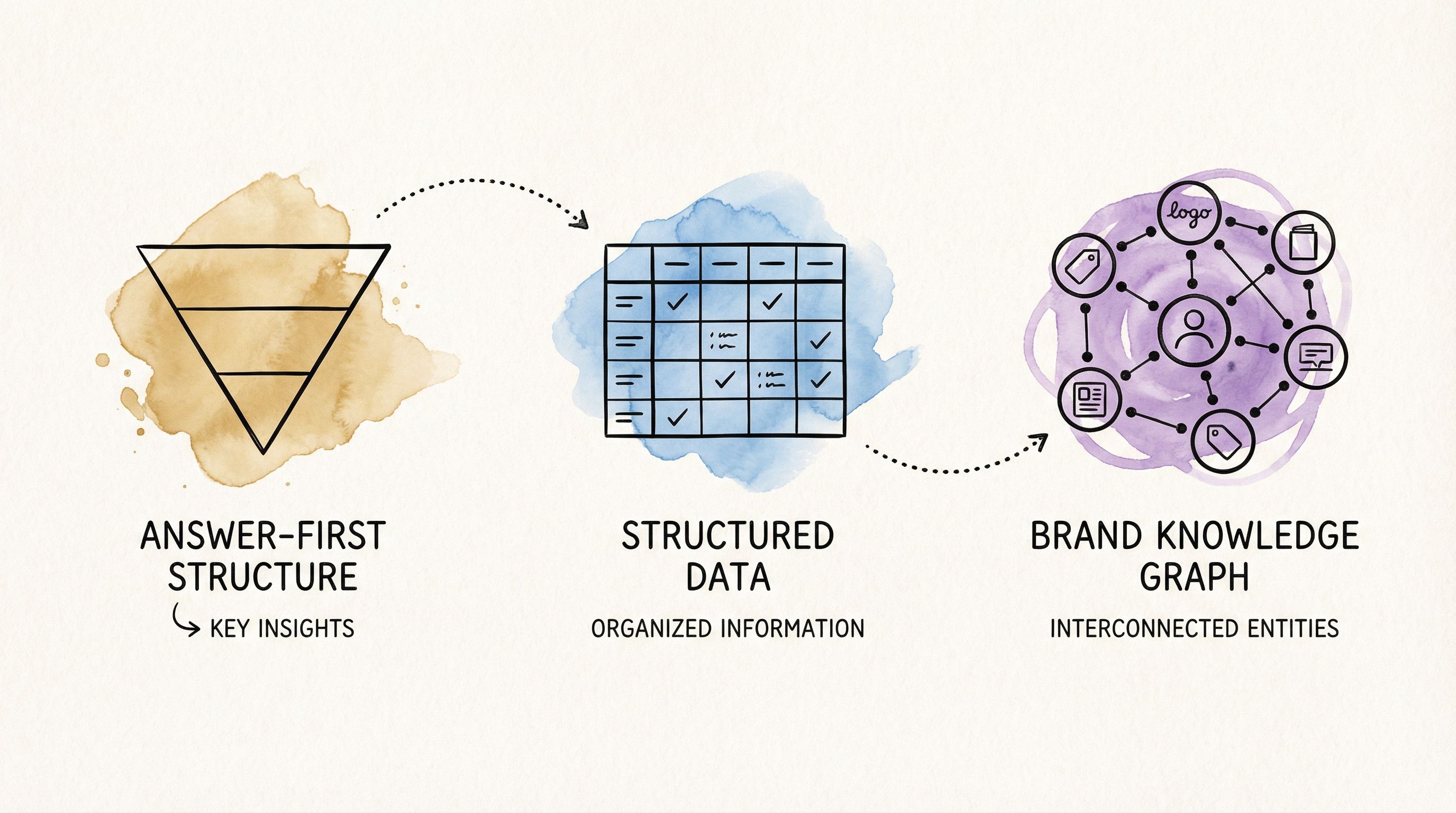
The 3 rules for AI-citeable content
1. The "Answer First" Format (BLUF)
LLMs operate on "prediction." They are looking for the most statistically probable answer to a question. You need to give them that answer immediately.
The Tactic: Every H2 header in your blog must be a question (e.g., "How do I scale a SaaS?"), and the very first sentence following it must be the direct definition or solution.
- Bad (Old SEO): "Scaling a SaaS is a complex journey that involves..." (200 words of fluff).
- Good (GEO): "To scale a SaaS, focus on net revenue retention (NRR) and automated upsells. The primary lever is..."
This is called BLUF (Bottom Line Up Front). It reduces the "cognitive load" for the AI, making your snippet the easiest one to scrape and cite.
2. Fact Density & Structured Data
AI loves structure. Unstructured text is hard to parse; tables, lists, and specific data points are gold.
The Tactic: Stop using vague quantifiers like "many users." Use specific stats ("74% of users"). More importantly, use Comparison Tables. LLMs are frequently asked "X vs Y" questions. If you provide a clean Markdown table comparing your solution to a competitor, the AI is highly likely to reproduce that table verbatim in its answer.
3. Build a "Brand Knowledge Graph" (Co-Occurrence)
This is the most overlooked factor. AI doesn't just look at your website; it looks at the entire internet to see how your brand is discussed.
If you want to be cited as an expert on "Startup SEO," you need to ensure the words "Your Brand" and "Startup SEO" appear together in multiple places—Reddit threads, Quora answers, and niche forums. This builds a probabilistic association. When a user asks, "Who is the best at Startup SEO?", the model recalls your brand because the probability of those words co-occurring is high.
Comparison: Old SEO vs. The New GEO
| Feature | Traditional SEO (Google) | Generative Optimization (GEO) |
|---|---|---|
| Primary Goal | Rank #1 on a results page. | Be the single "cited source" in an answer. |
| Key Metric | Clicks / Traffic. | Citations / Share of Model. |
| Content Structure | Long-form, "Complete Guides." | "Answer First" (Definitions, Data, Tables). |
| Authority Signal | Backlinks (Quantity). | Entity Co-occurrence (Context). |
| Target Audience | The Browser (Human). | The Parser (AI). |
Implementation Plan: Start This Today
You don't need to rewrite your entire blog. Start with your top 5 converting pages:
- Rewrite the Intros: Cut the storytelling. Put the core "Answer" in the first 100 words.
- Add a "Key Takeaways" Box: Place a bulleted summary at the very top of the article. AI scrapers prioritize this.
- Insert Unique Data: Add one proprietary chart or table that doesn't exist elsewhere. This forces the AI to cite you if it wants to present that data.
The Role of Citation Intelligence
The hard truth is that you can't improve what you don't measure. In the old world, you had Google Search Console. In this new world, you have no idea if ChatGPT is recommending you or your competitor.
This is exactly why we built Beonai. We don't just guess; we track your visibility across AI models to tell you exactly where you are being cited and why your competitors are winning certain intent clusters.
The shift is happening now. You can either keep optimizing for 2015, or you can start building for the engine that actually answers the question.
Track What Actually Matters
Most "AI Visibility" tools are passive dashboards. They show you a pretty chart of your visibility dropping, but they don't tell you how to fix it.
Beonai is different. It is an Action Engine.
1. Measure the Impact (The CFO's Favorite Part)
- Multi-LLM Visibility: Track your Visibility Score across ChatGPT, Gemini, and Perplexity in real-time.
- Share of Voice (SOV): Know exactly how often AI recommends you vs. your competitors.
- Sentiment Analysis: Fix reputation issues before they spread by tracking positive vs. negative brand descriptors.
- Competitor Metrics: See which competitors dominate which prompts—and why.
- Citations Analysis: Identify exactly which third-party sources are driving your AI mentions.
2. Execute the Strategy (The Marketer's Favorite Part)
- Actionable Opportunities: Receive specific, weekly tasks to improve your citation velocity. No guessing.
- Content-Gen Workflows: Use our AI-assisted tools to build the exact "Data Magnet" blogs and reports that LLMs love to cite.
- Conversation Tracking: Identify and engage in the Reddit threads and forums where your brand is being discussed right now.
You are moving your money to the future. Make sure you have the tools to win there.
Common questions
Does GEO replace SEO completely?
No. Traditional search is still massive for navigational queries (e.g., "login page"). GEO is for informational and commercial intent (e.g., "best CRM for startups"). You need a hybrid strategy.
How long does it take to get cited by AI?
It is slower than Google indexing. LLMs are conservative. Expect a 6-12 month lag unless you have high "Entity Authority" or unique data that goes viral.
Can I just use AI to write my content?
Ironically, no. AI models are trained on AI content, which leads to "model collapse." To get cited, you need net new information—original opinions, contrarian takes, or proprietary data that the model hasn't seen before.
What is the most important on-page element for GEO?
The Header structure. Use H2s as direct questions (matches user intent) and H3s for the specific steps. Use Schema markup (FAQPage) to make it machine-readable.
Why is my traffic dropping even if I am cited?
This is "Zero-Click" behavior. The user gets the answer from the AI and doesn't click. This is why you must optimize for Brand Awareness and Revenue (people searching for your brand later) rather than just direct blog traffic.