

How to Check Your AI Visibility Manually Across LLMs
TL;DR
Most brands check their AI visibility by asking ChatGPT, "What is [My Brand]?" once. This is vanity, not data. To get the truth, you need a "Clean Room" environment, a list of "Unaided" prompts, and the discipline to run them thousands of times to beat the randomness. You *can* do this manually with a spreadsheet, if you have 20 hours a week to spare.
The "Vibes-Based" Audit
You open ChatGPT. You ask, "What is the best tool for [My Industry]?" It lists your brand at #1. The marketing team high-fives.
You just fell for the Personalization Trap.
LLMs like ChatGPT and Gemini have long memories. If your team has pasted pitch decks, code, or blog posts into that chat window before, the AI knows who you are. It is biased to give you the answer you want.
Furthermore, AI is probabilistic, not deterministic. Google gives the same result to everyone in New York. ChatGPT might give five different answers to five different people. A single screenshot proves nothing.
To measure visibility that actually drives revenue, you need to strip away the bias and measure the probability of your brand appearing to a cold prospect.
Phase 1: The "Clean Room" Protocol
Before you type a single prompt, you must sanitize your environment.
- Log Out: Do not use a corporate, logged-in account. The model uses your history to "personalize" answers.
- Incognito Mode: Use a fresh browser window to clear cookies and local data.
- VPN (Optional but Recommended): If you sell to the US but are based in London, the AI will give you localized results. Use a VPN to simulate a user in your target market.
Phase 2: Reverse-Engineer the Prompts
Do not ask about your brand. Real buyers don't start with your name; they start with their problem. You need two types of prompts:
1. Unaided Prompts (Discovery)
- The Goal: See if you appear when the user doesn't know you exist.
- How to find them: Type your main keyword into Perplexity or Google but don't hit enter. Look at the auto-complete suggestions. These are the real questions humans are asking.
- Examples:
- "Best affordable CRM for real estate agents."
- "How to automate invoice collection for small business."
- "Alternatives to Salesforce."
2. Aided Prompts (Reputation)
- The Goal: See how the AI describes you when asked directly. Is it hallucinating old pricing? Is the sentiment positive?
- Examples:
- "Pros and cons of [Your Brand]."
- "Is [Your Brand] legit?"
- "[Your Brand] vs [Competitor]."
Phase 3: The "Rule of 5" (Probabilistic Testing)
This is where the manual work begins to pile up. Because AI rolls the dice every time it answers, a single check is statistically meaningless. You must run your key prompts 5 times in new chat windows to get a baseline.
- Run 1: You are listed.
- Run 2: Competitor is listed.
- Run 3: You are listed.
- Run 4: You are listed.
- Run 5: Competitor is listed.
Your Score: 60% Share of Voice (SoV). Track this number in your spreadsheet, not your "rank."
Phase 4: Audit the "Supply Chain" (The Secret Weapon)
This is where you win. When an AI like Perplexity or Bing Copilot gives an answer, it cites its sources (the little numbers like [1] or [2]).
Click them.
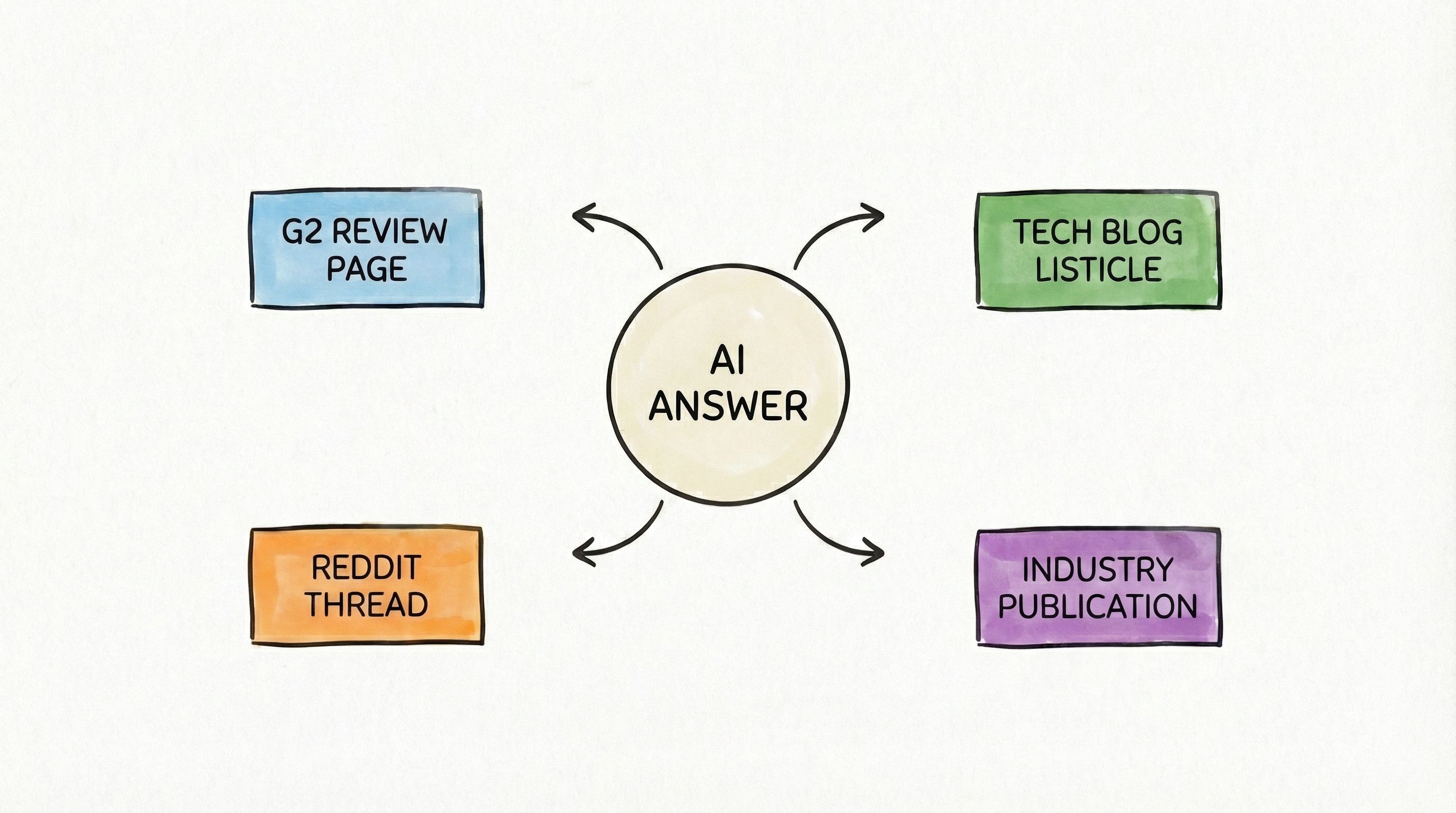
AI citations come from trusted sources
- Is the AI pulling from a G2 review?
- Is it pulling from a specific Reddit thread?
- Is it pulling from a "Top 10" listicle on a random tech blog?
This is your SEO roadmap. The AI doesn't "know" anything; it just summarizes these specific pages. If you want to change the AI's answer, you don't optimize your website—you optimize those third-party sources.
The Reality Check: Can You Actually Do This Manually?
If you followed the guide above, you might have realized the math doesn't work in your favor.
Let's calculate the workload for a standard audit:
- 20 Strategic Prompts (The bare minimum for a brand)
- x 3 Platforms (ChatGPT, Perplexity, Gemini)
- x 5 Iterations (To account for randomness)
- = 300 Manual Chats per Audit.
That is 300 times you need to open an Incognito window, toggle your VPN, paste a prompt, analyze the output, check the citations, and log the data in a spreadsheet.
If you do this once a month, it's a grueling two-day task. If you do this once a week (which you should, because AI updates daily), it's a part-time job.
You cannot scale Generative Engine Optimization (GEO) with a spreadsheet. The data moves too fast.
Track What Actually Matters
Most "AI Visibility" tools are passive dashboards. They show you a pretty chart of your visibility dropping, but they don't tell you how to fix it.
Beonai is different. It is an Action Engine.
1. Measure the Impact (The CFO's Favorite Part)
- Multi-LLM Visibility: Track your Visibility Score across ChatGPT, Gemini, and Perplexity in real-time.
- Share of Voice (SOV): Know exactly how often AI recommends you vs. your competitors.
- Sentiment Analysis: Fix reputation issues before they spread by tracking positive vs. negative brand descriptors.
- Competitor Metrics: See which competitors dominate which prompts—and why.
- Citations Analysis: Identify exactly which third-party sources are driving your AI mentions.
2. Execute the Strategy (The Marketer's Favorite Part)
- Actionable Opportunities: Receive specific, weekly tasks to improve your citation velocity. No guessing.
- Content-Gen Workflows: Use our AI-assisted tools to build the exact "Data Magnet" blogs and reports that LLMs love to cite.
- Conversation Tracking: Identify and engage in the Reddit threads and forums where your brand is being discussed right now.
You are moving your money to the future. Make sure you have the tools to win there.
Common questions
How often should I run a manual audit?
If you are doing it manually, aim for once a month for your top 10 "money-making" prompts. If you launch a major new feature or change pricing, check immediately. If you use Beonai, we track this daily automatically.
Does my physical location matter?
Yes. An AI might give different answers to a user in New York vs. London. If you are a global brand, you *must* use a VPN to simulate checking from your target countries, or the data is useless.
What if the AI gives the wrong pricing?
This is common hallucination. It means the AI is reading an outdated blog post about you, not your current site. Identify the source (using Perplexity citations) and try to get that old article updated. You can't "edit" the AI, but you can edit the internet it reads.
Can I just use the same prompt every time?
Yes, consistency is key. To track progress, you must ask the exact same question every time. If you change the wording even slightly (e.g., "best tool" vs. "top tool"), you change the mathematical probability of the answer.